
Trace Rowan Federal Transfers
Start with RCDC when the person was physically held in Rowan. Ask for transfer time, legal authority, destination, receiving agency, detainer clearance, and transport entry if maintained. A USMS pickup establishes a handoff, not entry into a particular BOP prison and not community release.
Next inspect the federal docket for detention, judgment, sentence, amendments, and supervised-release terms. A sentenced person may then appear in BOP's locator. Match register number and identity fields. Federal placement can occur anywhere, so the absence of a Rowan institution is normal.
At imprisonment's end, preserve the displayed BOP date and wording. If it says released or not in BOP custody, consult BOP's explanation and check the docket for supervision. Federal supervised release is not administered by KDOC. If ICE or a state agency assumed custody, verify that separately.
This chain prevents two mistakes: calling county-to-federal transfer freedom and treating the end of BOP custody as the end of every legal restraint. Each agency proves only its part of the timeline.
Releases from the Federal Bureau of Prisons
BOP operates the federal prison system. Its public locator covers federal inmates from 1982 forward and can display a release date with “Released” or “Not in BOP Custody.” A past date without a current facility generally indicates release from BOP custody. The wording does not mean the person has no supervised release, pending case, state sentence, local hold, or ICE custody.
Federal pretrial detainees may be managed by the U.S. Marshals Service and housed in contract space. USMS does not provide a comparable general historic released-person locator. Use the federal court case or appropriate district contact for that custody episode.
Confirm a Federal Prison Release
- Open the official BOP Inmate Locator.
- Search by BOP register, DCDC, FBI, or INS number when known, or use the name search.
- Match the full name, age, race, sex, and register number rather than relying on name alone.
- Read the facility and date exactly as displayed.
- Consult BOP's record explanation before interpreting “Released” or “Not in BOP Custody.”
- Use the federal docket or agency record for the legal reason and formal documentation.
- Check Kentucky, Rowan, or ICE sources separately only when the custody history supports them.
The Rowan County search path keeps those sovereign systems separate.
BOP Records and Contact Route
No Rowan County BOP institution contact card applies because research identified no federal prison in the county. The national locator is the first public channel. For formal evidence, use BOP's records procedures or the relevant federal court and agency record. Include the register number and complete identity information so the request does not confuse people with similar names.
A locator result is a public navigation record, not a certified discharge packet. Ask for existing records and identify the federal custody episode and approximate release date.
About Federal Custody Serving Rowan County
Federal jurisdiction depends on the case, not the person's county of residence. Someone arrested in Rowan County can have a local or state matter with no BOP connection. Conversely, a Rowan resident convicted federally may be housed anywhere in the national system. Do not search BOP merely because a name vanished from RCDC.
A transfer from RCDC to USMS or BOP authority is continued custody. The RCDC transaction or transport record may identify the receiving agency, and the federal docket can explain the case.
Reading a BOP Release Result
The displayed date must retain its BOP meaning. It may document the end of BOP custody, but it is not automatically the end of the federal sentence because supervised release can follow incarceration. It also cannot establish that another sovereign did not take custody. Search the relevant system for the next event instead of extending the federal label beyond its scope.
Older records before the locator's stated coverage require archival or agency routes. Spelling variants and aliases can affect name searches, so stable numbers are preferable.
BOP Locator Example and Limits
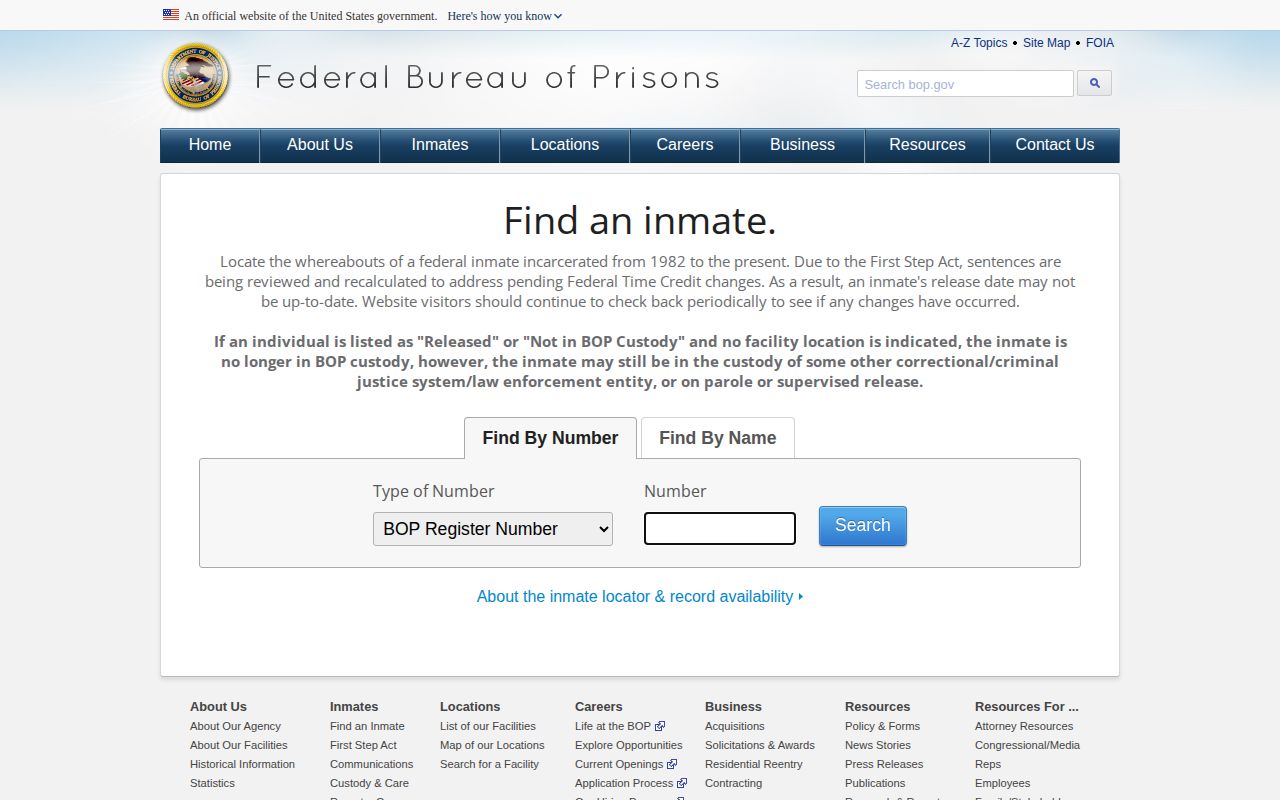
The BOP locator provides both name and number search routes.
Federal Release Versus Supervision
Federal supervised release is imposed and managed through the federal court and probation system, not Kentucky Probation and Parole. A BOP release result therefore should be paired with the sentencing docket when continuing federal conditions matter. The public locator is not a supervision directory.
Federal Court Records Complete the Timeline
The federal docket can identify the judgment, sentence, later modifications, supervised-release term, and relevant orders. BOP records document institutional custody and its end. These sources should be paired because sentencing date, projected date, and physical release date answer different questions. A court order may explain why a date changed.
For a person held in local space under federal authority, request the RCDC transaction if Rowan was the physical custodian and use the federal docket for legal authority. The receiving-agency field can distinguish a federal handoff from community release.
Federal Detainers and Other Sovereigns
A federal detainer can affect departure from state or county custody. Conversely, a state warrant or ICE action can follow BOP release. No universal search combines these systems. Start with the agency that actually held the person, then follow the documented destination instead of merging unrelated matches.
Identity checks are especially important across sovereign systems because number formats differ. Preserve the BOP register number separately from state DOC, county booking, court case, and immigration A-numbers.
Projected and Actual Federal Dates
A future date displayed by BOP should retain its source label and can change due to sentence computation, court action, credits, or another legal event. A past date is stronger evidence that BOP custody ended, but the formal agency record remains the durable confirmation. Do not create a countdown or promise release at a particular hour.
If the locator has no match, confirm spelling and number, consider the 1982 coverage boundary, and ask whether the person was a federal pretrial detainee rather than a sentenced BOP prisoner. The appropriate federal district or records office may be the only route.
Photographs and Federal Records
The locator's purpose is custody and release navigation, not a mugshot archive. A photograph from a county booking, federal filing, or another agency belongs to that source event. Do not use an image to match a federal record without corroborating identifiers, and do not infer conviction or current custody from an old photograph.
Formal record requests should identify the document sought rather than ask the agency to compile a biography or answer broad questions.
Search Public Records
Sponsored Results
Read Federal Release Dates
The BOP Inmate Locator covers federal inmates from 1982 forward. Search by BOP register number when known because it is more precise than a name. The system also accepts DCDC, FBI, or INS identifiers and offers name searching with age, race, and sex filters. Compare all displayed identity fields. Save the register number, lookup date, exact release date, and location or status wording from the matching result.
BOP explains that a past release date with no facility generally indicates that the person left BOP custody on that date. “Released” or “Not in BOP Custody” has the same limited reach. It does not decide whether supervised release continues, whether a state or local sentence remains, or whether immigration authorities assumed custody. First Step Act recalculations can also change a projected date. Treat a future date as a current agency projection, not a guaranteed exit appointment.
For confinement before 1982, follow National Archives guidance rather than assuming no federal record exists. For a federal pretrial prisoner, use PACER, the clerk of the relevant United States District Court, counsel, and the responsible United States Marshals Service district. USMS manages federal pretrial custody and transportation but does not offer a general historic released-person locator. Switch to BOP only after the person enters that system.
A federal docket can show the judgment, imprisonment term, sentence amendments, and supervised-release conditions. It may not give the precise physical departure time. If the locator and docket leave a gap, request the specific federal record from the agency that created it. Keep Rowan jail, USMS, BOP, court, and any later ICE dates as separate events.
No federal prison was identified within Rowan County. A local connection describes the person or an earlier custody episode, not the physical location of a BOP institution. Follow the agency chain instead of limiting the locator search to Kentucky.